
Book Review: Common Ground Between Islam & Buddhism
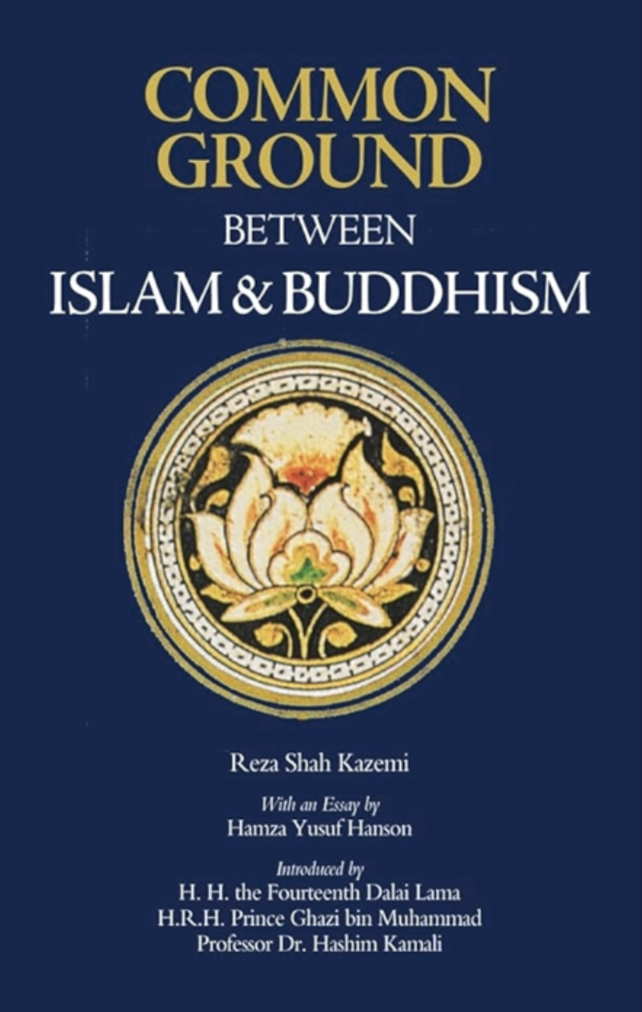
Book: Common Ground Between Islam and Buddhism
By Reza Shah Kazemi
With an essay by Shaykh Hamza Yusuf
Introduced by H.H. the Fourteenth Dalai Lama, H.R.H. Prince Ghazi bin Muhammad, and Prof. Mohammad Hashim Kamali
Book Reflection by Br. Abdel Kader Darwich
Introduction
I was finally able to finish reading Common Ground Between Islam and Buddhism shortly before Ramadan—a time uniquely suited for introspection, self-critique, and purification of intention. Ramadan reminds Muslims that faith is not merely inherited but continuously renewed through reflection and discipline. In this sense, engaging with a book that challenges one’s assumptions about “the other” felt particularly appropriate.
At first glance, the title itself may unsettle some readers. For many Muslims, placing Islam and Buddhism side by side raises immediate theological alarms. Yet this instinctive reaction is itself worth examining. The Qur’an repeatedly calls believers to reflect, to listen, and to avoid judging without knowledge:
“And do not pursue that of which you have no knowledge. Indeed, the hearing, the sight, and the heart—about all those [one] will be questioned.”
(Qur’an 17:36)
Sometimes, it is precisely an unsettling title or unfamiliar comparison that forces us to confront inherited assumptions rather than consciously chosen beliefs.
What the Book Is—and Is Not
It must be stated clearly that this book does not attempt to merge Islam and Buddhism, nor does it promote theological relativism or religious syncretism. On the contrary, it openly acknowledges the profound and irreconcilable differences between a strictly monotheistic religion such as Islam and a non-theistic tradition such as Buddhism. This honesty is one of the book’s strengths.
Islam’s doctrine of tawḥīd is uncompromising. The Qur’an states:
“Say: He is Allah, One. Allah, the Eternal Refuge. He neither begets nor is born.”
(Qur’an 112:1–3)
Buddhism, by contrast, remains largely silent on the question of God. Rather than attempting to resolve this tension artificially, Reza Shah Kazemi treats it with intellectual integrity. The book’s goal is not theological unification, but the identification of a common ground—ethical, spiritual, and civilizational—between nearly 1.9 billion Muslims and roughly 400 million Buddhists.
Confronting Misconceptions About Buddhism
One of the most impactful aspects of the book was how directly it confronted my own preconceptions. Like many Muslims, I approached the book with the assumption that Buddhists are idolaters (وثنيين) who worship statues of the Buddha. This belief is widespread in Muslim communities, yet rarely examined critically.
The book demonstrates that this assumption is largely inaccurate. Buddhism is a non-theistic tradition; it does not affirm or deny the existence of a Creator God, but instead focuses on understanding suffering and cultivating liberation through ethical living, mental discipline, and insight. Statues of the Buddha are not objects of worship, but symbols—visual reminders of enlightenment and compassion.
This distinction between worship and reverence is crucial, and Islam itself recognizes such nuance. The Qur’an criticizes idol worship not merely because images exist, but because they are believed to possess divine power:
“They worship besides Allah that which neither harms them nor benefits them.”
(Qur’an 10:18)
Reverence without divinization is not equivalent to shirk. Understanding this distinction is essential for honest engagement.
Theological Boundaries and the Question of Prophethood
Kazemi presents one of the most sophisticated arguments I have encountered suggesting that the Buddha could be considered a prophet. He draws upon Islamic teachings that affirm the existence of prophets whose names are not mentioned in the Qur’an:
“And We have certainly sent messengers before you. Among them are those We have related to you, and among them are those We have not related to you.”
(Qur’an 40:78)
This verse leaves open the possibility that divinely inspired figures may have existed beyond the Abrahamic narrative. However, despite the strength of Kazemi’s argument, I remain unconvinced. For me, the Buddha’s silence on the existence of God remains a decisive theological obstacle. While silence is not denial—and the Buddha did not negate the existence of God—it nonetheless marks a critical divergence from prophetic discourse as understood in Islam.
That said, the discussion itself is valuable. Islam encourages reasoned disagreement grounded in respect and evidence:
“Invite to the way of your Lord with wisdom and good instruction, and argue with them in a way that is best.”
(Qur’an 16:125)
Are Buddhists Ahl al-Kitāb?
One of the most intriguing sections of the book concerns whether certain Buddhist traditions—particularly Mahayana and Pure Land Buddhism—might fall under shubhat ahl al-kitāb (شبهة أهل كتاب), meaning a resemblance or proximity to the People of the Book.
Some scholars note that Buddhist notions of Ultimate Truth resonate, at least conceptually, with the Qur’anic emphasis on al-Ḥaqq (الحق):
“That is because Allah—He is the Truth, and what they invoke besides Him is falsehood.”
(Qur’an 22:62)
While these parallels should not be overstated, they complicate simplistic classifications. Importantly, Islamic jurisprudence has historically shown flexibility. Muslim rulers extended dhimmī (ذمي) status to Buddhists, granting them protection and religious freedom. This historical reality demonstrates that Islamic governance often operated with pragmatic wisdom rather than rigid theological abstraction.
Shaykh Hamza Yusuf and Al-Khiḍr
Shaykh Hamza Yusuf’s essay is one of the book’s intellectual highlights. Drawing on Imam al-Shahrastānī, he explores the possibility that al-Khiḍr (الخضر)—the enigmatic figure in Surat al-Kahf—could correspond historically to the Buddha.
The Qur’anic account of al-Khiḍr emphasizes hidden wisdom beyond conventional understanding:
“Indeed, you will not be able to have patience with me. And how can you have patience for what you do not encompass in knowledge?”
(Qur’an 18:67–68)
Whether or not one accepts this identification, the discussion exemplifies Islam’s deep intellectual tradition and its willingness to engage other civilizations thoughtfully—always concluding, as Shaykh Hamza does, with wa-Allāhu aʿlam.
Learning Without Losing One’s Faith
Prince Ghazi bin Muhammad’s contribution is particularly insightful. He explains how studying Buddhism strengthened his Islamic practice rather than weakening it. Concepts such as asceticism (الزهد), self-discipline, and control of the ego (مجاهدة النفس) are deeply developed in Buddhism, yet they resonate profoundly with Islamic spirituality.
The Prophet ﷺ said:
“The strong one is not the one who overcomes others by force, but the one who controls himself while in anger.”
(Ṣaḥīḥ al-Bukhārī & Muslim)
Likewise, the Qur’an praises restraint and self-mastery:
“As for the one who feared standing before his Lord and restrained the soul from desire, then indeed, Paradise will be [his] refuge.”
(Qur’an 79:40–41)
Learning from others does not necessitate imitation or conversion.
Academic Depth and Final Reflections
Some portions of the book are academically demanding, but they remain accessible with careful reading. The effort is well rewarded. This is not a book to be skimmed, but one to be engaged thoughtfully.
In conclusion, Common Ground Between Islam and Buddhism is a courageous and necessary work. It does not dilute Islamic belief, nor does it romanticize Buddhism. Instead, it invites Muslims to embody the Qur’anic ethic of justice, understanding, and intellectual humility:
“O mankind, indeed We created you from male and female and made you peoples and tribes that you may know one another.”
(Qur’an 49:13)
Understanding the other does not weaken faith. When grounded properly, it refines it.
