Reflection: A Vulnerable Heart, A Merciful God
By Navishtah Shah
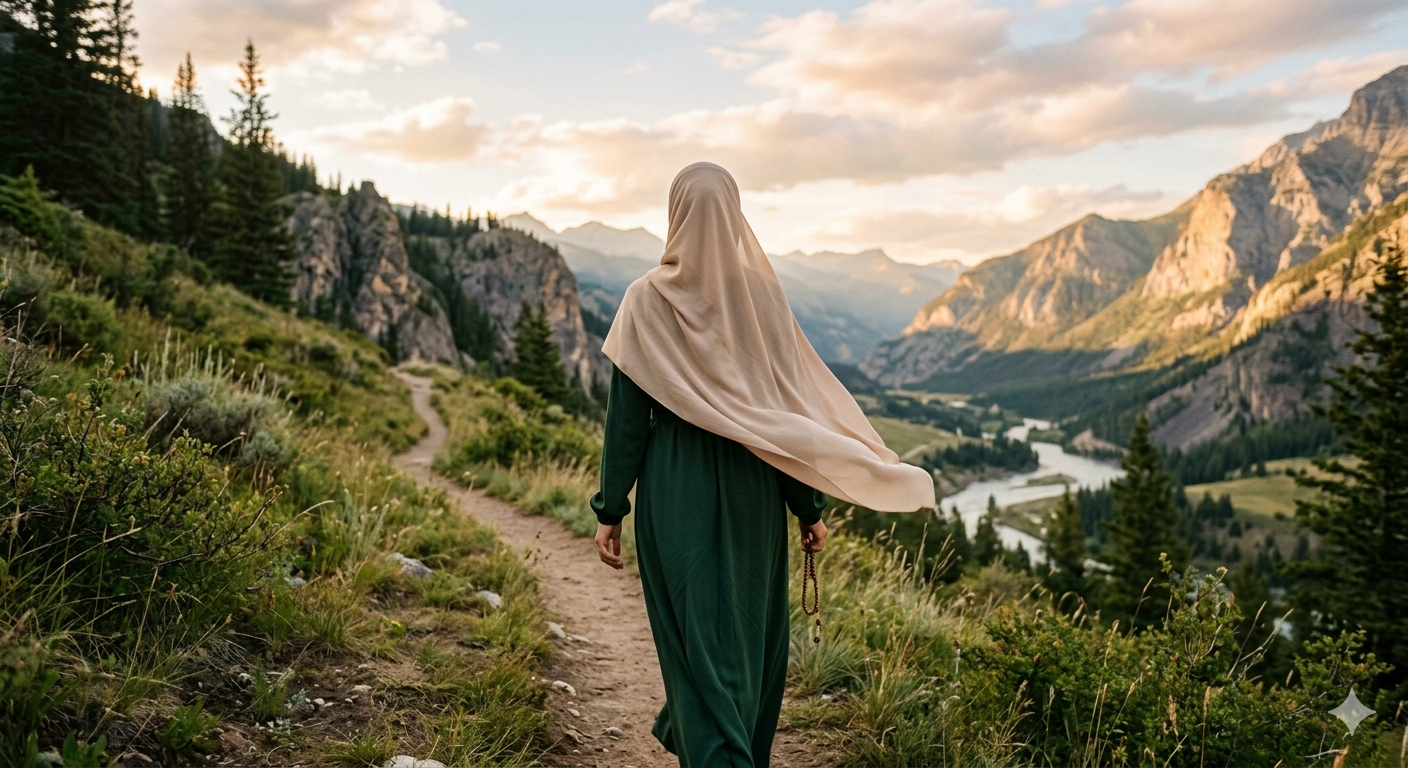
I feel it every day in my body, the physical weight of all that I carry. My back feels like bricks, as though I am carrying a heavy load on it. Most days, I do not notice the ache until I finally find a moment of rest at the end of the day.
I carry the weight of the many roles I inhabit: mother, wife, daughter, elder sister, leader, coach, friend, and student. I am all of this, and yet I still struggle to define who I really am.
Over time, I sensed a disconnect between my body and my inner state. I often told myself, “I feel stuck.” I wanted to move forward in my life without carrying this heaviness, this burden of identity and role based responsibility. More than anything, I felt dissatisfied with my level of spiritual integrity. I knew I wanted to know myself more truthfully and draw closer to my Creator.
And yet, this desire came with a deep loneliness. I felt fear.
Allah says in the Quran:
“Moreover, He is the One Who brings about joy and sadness.”
(Surah An Najm 53:43)
This verse reminds me that joy and sorrow, laughter and tears are not random states. They are part of how Allah created us.
Joy, fear, sadness, hurt, and anger are not incidental to my life. They are guides. Gifts from Allah. They are part of my fitrah.
I grew up believing that some emotions were good and others were bad. As I matured, I began to understand that my emotions are neither good nor bad. They are signals and truths within me waiting to be listened to. My intention now is to express myself both authentically and responsibly.
The persistent heaviness in my body and the overwhelm of daily life eventually led me to ask a simple but confronting question: What am I actually feeling?
Historically, I have struggled to express my emotions fully. I was raised in environments where the expression of certain feelings such as pain, anger and sadness were not welcomed. This left me wondering: Why does expression matter? Isn’t naming the emotion and being aware of it enough?
What I came to understand through both lived experience and study is that unexpressed emotions remain active in the body. They are acknowledged, but not resolved. For me, unexpressed emotions showed up as physical pain, heightened stress, irritability, and difficulty focusing.
Emotional regulation is not only about identifying what we feel. It is also about understanding its message and allowing it to move through us in a truthful and responsible way. When emotions are continually contained but never expressed, the heart hardens and the body bears the cost.
For some time, I practiced naming my emotions again and again. Slowly, that naming created enough safety for expression to follow. When it did, my hurt and anger did not come out as words at first.
They came out as tears.
For most of my life, tears felt unsafe. I thought I was weak for exposing my vulnerability. Yet when I finally chose to let them flow, without explanations, without analysis, something inside me shifted. My body felt more relaxed and grounded. I could see myself more truthfully. My tears were not a loss of control. They were a softening of the heart.
Islam does not teach us to suppress the heart in pursuit of closeness to Allah. It teaches us to bring the heart fully into the relationship. The Quran describes hearts that soften and tremble in remembrance:
“˹It is˺ Allah ˹Who˺ has sent down the best message—a Book of perfect consistency and repeated lessons—which causes the skin ˹and hearts˺ of those who fear their Lord to tremble, then their skin and hearts soften at the mention of ˹the mercy of˺ Allah. That is the guidance of Allah, through which He guides whoever He wills. But whoever Allah leaves to stray will be left with no guide.”
(Surah Az Zumar 39:23)
Tears, I learned, are one of the ways the heart softens. They open us. They allow receptivity. They make space for mercy to be received rather than resisted.
Under the lace of rose washed hues
Coiled between the strokes
of brisk ocean blues,
Skipping along the warmth
of the sun's citrus trees
Perching beneath the whispers
of autumn leaves
there is a light
for most,
unseen
there is a light
that awakens
the gentle beats
of a heart
that seeks refuge
in the mercy of
Ar-Raheem.
This vulnerability, I came to understand, is not weakness. It is the willingness to be seen as I truly am before myself and before Allah. It is standing without armor.
This vulnerability brings alignment. I want my inner state to match my outer life. I no longer want to ask my body to carry what my heart refused to acknowledge. In this alignment, authenticity can take root.
Authenticity, in this sense, is not self indulgence. It is responsibility. It is truthfulness with oneself about one’s inner state. This gives space for transformation. When I suppressed my pain, I abandoned a part of myself. When I allowed myself to feel and express it, I held myself with honesty and integrity. I was with myself.
My tears have softened me. They strip away performance. They return me to myself. And in that return, I find a quieter, steadier closeness to Allah rooted not in perfection, but in honesty. What I carry today has not disappeared. The roles remain. The responsibilities remain. But I am learning how to shift the weight. I am learning to no longer carry it alone and silently.
Author
Navishtha Shah is currently an Islamic studies student at the Tarbiya Institute Seminary, integrating spiritual depth with emotional intelligence in her life coaching and leadership work.
References
The Qur’an:
An-Najm 53:43; Az-Zumar 39:23.
